Monday, January 28, 2013

Can't Hide a Damn Thing...


Play it and you'll get the point.


People pick up where they left off. If you've been to a reunion or run into someone you haven't seen in years, you unconsciously revert back to that time and start anew. I'm not talking about the progression of life you tell each other that's occurred “since then,” (though that happens), but your behavior and state of mind can revert back to that time. Chances are, you'll notice it and be surprised how you can transport your entire self to the past.

 
I saw A. recently. It was an accident really. These accidents I have happen mostly in Stop and Shops where I'm minding my own business. I ran into her in the checkout line and we did what we all do, feel surprised and played “catch up.” I've run into a few over the years at a Stop & Shop.

 
It probably took five seconds when I felt it. That old flame alit anew. Dammit, I saw those brown eyes and bang! I was hit once more.

 
Sure, we've both aged and looked it when we met, but that didn't matter. That girl I remembered was in her still. I find people never really change, not their core at least. The same mannerisms, body movements and little quirks, they last forever. She still had hers. I probably still have mine.

 
What was funny was that I telegraphed that old feeling I had pretty quick to her. Of course, she read it and responded in kind...till she remembered herself. To douse any fledgling flames, she brought up her kids and husband. Well, bringing up that shot me back to the here and now in seconds and reminded her of how very married she was. Ah well, the logical part of my brain took over then and reiterated why we had never lasted, but the heart...the heart..never listens..does it?


I've been on the opposite of that as well, so I know how precise you have to be in order not to send the wrong signal. Once unleashed, you gave that other person some false hope that'll crash pretty hard.

 
It's funny how we all do a little dance, with our radar on high, trying to sense if the other is inclined to firing up a romance. All those little messages we send one another. All are non-verbal too.

 
This has nothing to do with my meeting in Stop & Shop, but with non-verbal communication. I once worked for a few years with the deaf population on the East Bay in RI. I was hired and thrown into the deep part of that pool. I learned to sign and read sign fairly fast and over the years, became a decent amateur at it. In no way would I hire myself out as a translator in a court case. One minor slip up and I’ll be sued!

 
What is fascinating about the deaf is this. You cannot lie to them. The deaf, from birth, have had to communicate in any way possible and one of the things they learn is to read is your body language. Since they can't hear and probably not speak, they have to glean information in any other way possible. Body language gives away everything about you!

 
I'd take one along with me if I were to buy a new car, they'd spot the bullshit in seconds.

 
I learned about body language then, although my ability to read it has suffered over the years as my ASL skills haven't been used regularly, but still it's fun to watch how you, and others, speak volumes.

 
Here's a little secret some know, poker players mostly. Your iris widens when something pleases you. The deaf pointed that one out to me. I once used it as a “full steam ahead” message with Roberta a long time ago.

 
I was in the Last Call Saloon when I eyed this brunette behind me. I caught the eye contact, more eye contact and them more. I then dove in. I moved right up to her and said “Hi!” Her irises widened like she had been given a shot of Ketamine. I knew I was in!

 
That was a summer where I learned how the other half lives. The sort of obscenely well off. Well, to give her credit, she was a decent person who happened to be born to the right parents, well off ones.

 
Ok, here's another observation. This one works about 70% of the time the deaf told me and it only applies to women. When you meet one new one and look into her eyes, the eyes should be straight and both be able to zero right onto your face. They should be able to move in tandem without any apparent loss of tracking. Most women have these accurate eyes.

 
However...

 
You and I have met some where one eye seems to be wee bit off. They both track in the same direction but one eye is a few degrees off, as if it's looking just a little around you. After a few minutes you ignore it as it becomes a non issue. But the deaf told me, that's where you can find the sluts, some of the time.

 
The way it was explained to me, was that some of the deaf guys noticed that your chances of schtupping some chick were far greater if she had that one, just barely wandering eye. This isn't an assured 100% never fail bet, but it's better than 50/50 they told me.

 
Years later, I once told psychologist this story. He used to counsel PTSD patients and was interested in this story. He then opined that these girls the deaf were talking about had PTSD, in some form. It was probably from sexual abuse. Either from childhood, their teens or whenever. It caused the eye to drift. They don't really know why the eyes are involved.

 
“No wonder these women act out. You find many people with PTSD who unconsciously recreate their trauma...ad naseum.”

 
Did you know, that EMDR (Eye Movement and Desensitization and Re-learning) is an actual therapy for PTSD? It involves having the client dart their eyes back and forth as they concentrate on whatever miserable experience they had. Sometimes, the eyes will lose tracking and one will wander off a degree or two. Again, there is little understanding why this therapy can work well. Oddly enough, it's been backed up by studies as an effective method, except no one in the field can understand why it works.

 
Well, I've certainly gone off the subject here...or perhaps not. I still think body language is the key to understanding most people though. It wasn't a waste spending those years with the deaf.

Tuesday, January 22, 2013

Just Us Two Out There


It's so cold out, the dew point is below zero. That must be why my nose has been running of late. It's so dried out that my body is opening up the dams to flood the valley.

 
When it's dry like this, any static spark that could be created will be. My dog distrusts me now since each time I've scratched his head or nose, I've zapped him with a small, yet distinctly sounding “crack!” He thinks I hate him now. I've learned to ground myself on the door now or anything metal before I go near him. He also has wild fur, from the static. It looks like I've blow dried him.

 
I still find it surprising how animals can tolerate these cold snaps. I have to bundle up and I still find it a chore just to tolerate the single digit temperatures. My dog, on the other hand, seems oblivious to it. Why the pads on his feet not get frozen while walking on the snow, in the these woods, is still a mystery. The only sign of his being cold, is usually inside my house. He'll be rolled up, nose to ass, like a croissant roll, on top of the three blankets I have for him on the floor.

 
While walking him in the woods tonight, I heard something I haven't heard in a long while. Trees freezing. There was no wind out there at sunset tonight, so it wasn't the limbs banging into one another. I swear it's the wood-sap-water in them contracting. I didn't hear this once but a few times, near and far. Now that I think on it, it sounds just like cracking wood. I wasn't near the river or pond so it wasn't that, though that too can produce some unworldly sounds as it freezes up.

 
I didn't last long out there. The sun had just about set and that weird light was everywhere. I can't describe it except it was a strange, austere blue that was cast on everything. Just looking at it can tell you how damned cold it'll get tonight.

 
As I am deep enough into these woods with this time of day and the biting cold, I can unleash him and let him gallop as he wishes. There will be no one out here he can molest. He'll do a figure “8” around me as I walk along, sniffing everything imaginable, finding whatever under the snow.

 
As I said, I didn't last too long. I felt the skin on my back getting chilly and my hands were starting to sting so I called the dog. His head bolted upright towards me with an anticipating, questioning look. After a second or two he comes bounding back, thinking there's a snack ready. Apparently he wasn't done nor too cold as we got nearer my car. He kept stalling, waiting for me to turn back to have more fun. Nope, I kept going along, making a bee line to my car when it came into sight. He runs up eventually and bounces into the back seat.


Once home, after twenty minute or so, I warm up. He, on the other hand, is on his pile of blankets and will refuse to move for a few hours.


Saturday, January 19, 2013

Alex and Ani


I've never been to Bristol's Fourth of July parade and the only way I'd go is if I had an overnight place to stay. I used to work in Warren, RI a while back and driving on route 114 on that day is tedious. Instead I watch the parade on TV. During the last broadcast of it, I kept seeing these commercial spots, a lot of them, of a jeweler called Alex and Ani. Whoever was buying that much commercial time during the broadcast must have had a ton of money. I had never heard of Alex and Ani before that day.

 
What struck me was the high quality of the spots, the eco-friendliness and almost New Age-y style to them. They certainly managed to get a “lifestyle” feel for the commercials. You see these and they leave you with the feeling that you have just driven through Sonoma Valley or walked along some beach in the Vineyard. Each time one came on, I didn't look away. I'm a guy for God's sake and I'm not about to buy much jewelry, ever. But still, I had to watch.

 
I finally looked them up after hearing that Carolyn Rafaelian (the founder of Alex and Ani) bought the Belcourt Castle in Newport. This, after having purchased Sakonnet Vineyard down by Little Compton way. I guess she has so much money the banks turn her away now.

 
Apparently this jewelry company has been around for a while now. Rafaelian was in the jewelry business as a kid. Her parents ran a company and she learned it from the ground up.   Boy, did she find her niche! Her brand has exploded overnight! I looked up their company website and I see that she's opening up stores all over the country. She'll be able to buy Mars soon enough, I'm sure.

 
Nothing succeeds like success they say. I guess so! Though I swear there's a huge element of luck in involved. I can bet it was those commercials that did it for her, or at least the luck of hiring the right company to do them. Those spots grabbed by attention and I have no intention of buying their jewelry ever.

 
Hmm, the only jewelry I have bought, besides cheap leather wristbands, was one 20kt gold herringbone necklace back...in 1990? I forget why but I thought they looked cool and I plunked down the money to have it. I wore it for about one summer when my friend Matt accused me one night, while we were at the Last Call Saloon, of being a North Providence Guido.

 
“The only reason why your shirt is unbuttoned there is so you can show it...right? He asks.

 
“Well, sure...why not?”

 
“I can see it glinting at me from 20 feet away!!” He finally says, in disgust.

 
That was my only foray into bling.
 
Rafalian
 

Wednesday, January 16, 2013

Even Pawtucket Can be Pretty...


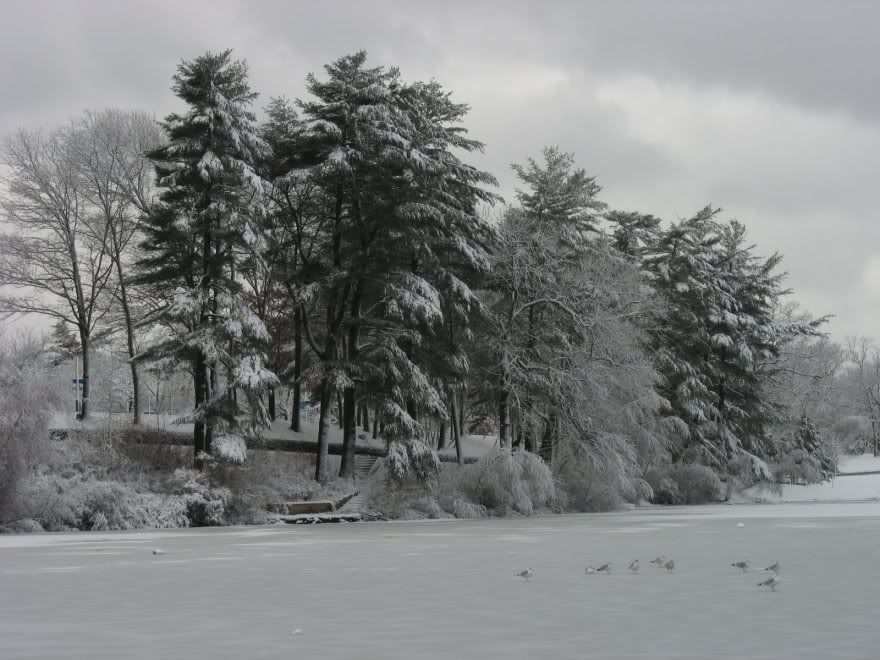
Slater Park Duck Pond


It snowed overnight, more than I thought. Had I been still in school I'd be disappointed that it wasn't enough to cancel it. One time in eighth grade, I stared out my front window and noticed that the snow in the street hadn't piled up past the 4 inch street curb opposite this house.
 
“Shit...gotta go to school today.” I said to myself.
 
I saw the unburied curb this morning and it's funny how a small memory from so long ago will come back to me.
 
Since it snowed, this will keep people in their homes and I can walk my overly rambunctious dog. He doesn't do too well when I take him to the park as there are a hundred other dog walkers there as well on nice days. To him, every other dog he sees within 100 feet must die or at least be growled and barked at. It's a pain to deal with. So, these snowy days are a relief in one sense.
 
There are a few times when Slater Park is actually beautiful in the snow. You have to go soon before it starts melting off the trees and before it fills up with people. I've never been to the Grand Tetons but there must be a sense of quiet that is somewhat comparable? In any event, when the park is unpopulated with people and the snow deadens the sound of the far off traffic, it is pretty quiet. I can imagine I'm at the bottom of some mountain pass.
 
I'm not sure if you can pick this up but you can smell the snow. Not only that, dry vs heavy wet snow each has it's own scent. To note this, it helps to be away from all the car/furnace exhaust that the suburbs belch out. The snow today has a very clean wet smell. That's not astonishing. I ordinarily barely notice that if I have a busy day. The odor is there but I'm too engrossed with trying to buy stamps or shop for food. I suppose what is striking is if I pay any attention to it at all. Well, this morning I did. When there are few distractions, you naturally will focus in on these things.

 
*****
 
I have an old friend who I hadn't seen in quite some time who used to man the weather post on top of Mt Washington...in January. I found it surprising and wanted to know what the weather and life was like up there during the deepest of winter. You can imagine how bitingly cold and isolated it is. It's that and in spades I was told.
 
So why go there? Why find, in essence, the most barren of places to live for a month?
 
It came to me a few days later. Peace and quiet.
 
The weather up there utterly compels you to be cocooned. Winter itself does that down here too to a lesser degree. I'm 80 feet above sea level and I usually hibernate in winter, though I'm not that constrained as I'd be atop a mountain. In either case, atop a mountain or in a local park, there's quiet to be found. It matters on how much stillness you want. My friend just found, probably, the best spot in New England in winter if you want to “get away from it all.” Of course, he wasn't entirely alone. The post is manned with scientists and others from NOAA. Ensconced like that does change how you feel and how you react to those around you. You learn to give one another privacy, even if there is only 200 square feet in that office you're both sharing. You just can't step outside for a cigarette, unless you want to be frozen solid in seven minutes, then blown off the mountaintop. 

If you're not the type to got batshit crazy from cabin fever, the top of this mountain probably has the remedy for peace you've been seeking. I'm not sure if I'd try it for that long, perhaps a few days, to see what it's all about.  
 
“Life can wear you down at times, especially as you get older.” B tells me. He should know, he's “up there.” He tells me it's not surprised people do this. Everyone goes on vacation. Everyone wants to get away from it all, and perhaps for a bit longer than your usual camping trip to Acadia. He himself purposely once demanded assignment to a NATO base in Greenland, called Thule.
 
Thule was a SAC airforce base 500 miles south of the North Pole. It was constantly frozen solid and it's purpose was to sit there and await the call from NORAD to fire up the FB-111's to fly to Russia and nuke it to hell. They never got the call, of course. He never did tell me what his position was in detail, except working along with GE, who were rewiring, reconfiguring the radar systems that dot the base.
 
“It takes a few weeks but the barrenness of rock, glacier and sea ice does calm you” he told me.
 
“What about boredom?” I ask.
 
“That, is part of your adjustment...there comes a point where you forget all about TV channels, radio, crowded cities and every other distraction that can tug at you...you learn to relax finally.”
 
“You sure picked the most out of the way place imaginable!” I tell him.
 
“Yep, six months of the year it's dark or barely twilight, it's so far north you're above the aurora circle, you never see it, that's how close to the Pole you are.”
 
“When I came back, via Labrador, Montreal and finally La Guardia, the hustle and bustle of the city didn't bug me in the least. My personality had remained changed after that for a good six months. Nothing really bugged me.” he went on.
 
I tell him, “After a vacation, people feel great for ONE day when they return to work...too bad it doesn't last long.”
 
“You haven't been far enough away!” he told me.
 
Ok, so I was 1.3 miles away from the suburbs this morning. It wasn't Mt Washington nor Thule, but it was a nice walk through the pines today, with a dog that couldn’t go ballistic on other animals.


Monday, January 14, 2013

Annoying the Elderly


I'm sitting here listening to the One Hit Wonders from 1978. God, they were so young then with hopes of being the next thing. The reason I hopped on to this was that Sammy Johns, who did the sugary Chevy Van song, died. See how a life of vile sin is answered with death?


Again, listening to these old songs is great for bringing up old stories.


Barry M. was an entertaing friend. He was the type of kid you could goad into doing anything if you mentioned how “fun” it would be to do. When we had our two weeks off during the blizzard of '78, we hung around where we always hung around, the mall plaza on Armistice Blvd. I guess we were the part of the original mall rats then. We were rats in every sense of the word. We brought nothing positive to that property. We were chased out by various store managers who shouted after us, “Don't you brats have anything better to do?” Again, we were bored and causing trouble was exciting.


The plaza always cleared their parking lot after each snow and the blizzard was no different. This time though, the mountains of snow reached perhaps fifth-teen feet high. It was like scrambling along the Himalayas when we played in them.


Though, that got boring soon enough.


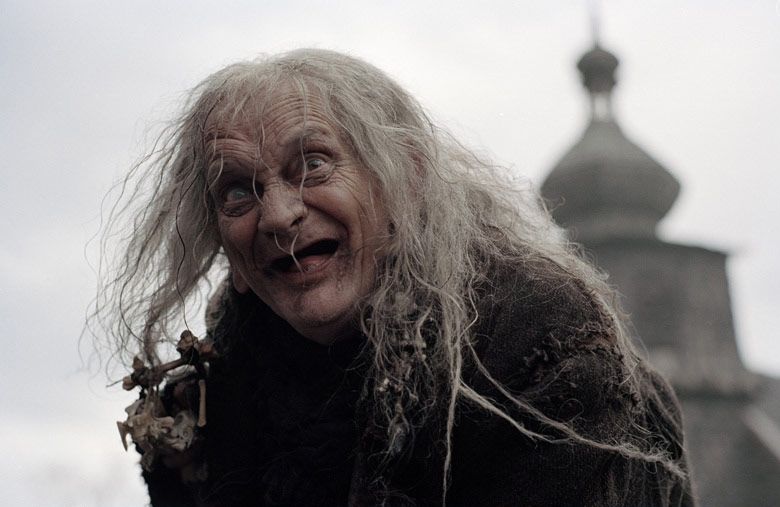
We were sitting ontop of one mountain of snow by the Egan's Laundromat when I, and Jimmy, noticed that old crone who used to manage it at nights. She looked to us like she was 98 years old. She was as ornery, wrinkly and bitchy as old women come. She never let us inside of her establishment knowing we were up to no good.


Barry was with us. He was grabbing two foot round boulders of snow and tossing them onto the street beside us. They'd splatter with a great poomf and Barry had thrown about ten of them into the street to create a pile of snow other cars started to drive around. I guess one of us, I forget who, suggested to Barry that he should get a boulder of snow, walk up to Egan's, let the automatic door open and toss the boulder as far as he could inside.


So, Barry, being ready to prove “he wasn't scared,” grabbed a good sized rock of snow and ambled off towards the store. The old crone inside was behind her counter and her sight of the door was blocked by a line of dry cleaning inside their plastic bags. Barry walked up to the door and flung in the snow boulder. We were about 20 yards back, hidden in the snow piles and had a bird's eye view as the boulder smashed onto the floor of the store, scattering quite far and that surprised us.


We busted out laughing. The old lady came running to the door but Barry had hidden himself rather quickly behind some parked cars. She then got the shovel and dug out the inside of her store, then mopped up the snow melt.


All good jokes have to be repeated you know. Barry came back to us and we told him to wait about 15 minutes before he did it again.


So, the second time he goes up, with a bigger boulder that he's having a hard time carrying. The door opens and this one doesn't go quite as far inside the store but it smashes with greater effect. He fled as fast as he could into the maze of parked cars while the old girl comes running out screaming obscenities. It was hilarious to hear an old women shout out, “You little FUCK! If I catch you I'm going to break both your arms!!”


We were well hidden and she had not a clue to us in the snow piles though. I'm surprised because we were laughing so hard that it struck me odd that she couldn't hear us.


So, we wait about 20 minutes before we send Barry in again. He gets the largest boulder he can find and again, has trouble carrying it to the front door. As he approached the door, this old women, who apparently had slipped out the back door and came around the dark side of the building, comes flying around the corner.  She moved at a startling speed that old people can sometimes have. It was more than fast enough because she grabbed his hair with a good yank.

We saw this and realized one of our own had been KIA. She shook Barry's head like a dog shakes a Raggedy Ann doll in it's mouth. Oh was she pissed! What did we do? We bravely abandoned Barry to his fate.


The next day, we found out she dragged him into the store, by his hair, and tortured him this way till he coughed up his Mom's phone number. Mom showed up, Mrs McK., a woman we learned to give wide berth to as her temper was glorious, and she shoved, prodded and forced her son into the car.


He wasn't bothered by this at all, as he was constantly being inflicted with his Mom's punishments. It was just another day at the McK's house.


Barry grew up eventually, married, had two kids and a decent career. His life was cut short when died suddenly last summer from an embolism.


Barry was never a “pre-criminal” He was just another rambunctious boy from our crowd. He gave us some great laughs from the stuff he'd pull from time to time. His greatest feat was getting two of the four Pawtucket Fire stations to show up at a fire he started. He found a pile of carbon paper, which flares like gunpowder when lit, behind the old Atlantic Mill store at the plaza. Too bad it was windy day as the little balls of fire managed to be sucked into the open door of the warehouse. No biggie, the fire was knocked down in minutes but the smoke from it was incredible.


C'mon. If this was doing your dry cleaning, you'd toss more than snowballs at her!

Wednesday, January 9, 2013

Zero Dark Thirty


Ok, so I'll tell you the story of how my brother with his dark sense of humor, ended up saving two kids from the insane temper of their abusive father.


I myself had something to do with it, a lot really. I goaded my brother into doing it. I procured the materials needed and acted as look out.


Before child abuse was a real crime, before there was national outrage over it, smacking your kid around in public was ignored by most people. Many refused to interfere with families that bashed their kids pretty heavily as well, as long as it didn't end up in broken bones. I know of one case, which I've written about before, where one girl had a constantly broken right or left arm and who saved her? It wasn't the State but her aunt. No one really interfered in that particular family either, save a relative.


The Carlsons who I used to play with were a family of three boys and one very short tempered Dad who went from calm to ballistic in about four seconds. The parents corralled their boys like you would a pen of dogs, with shouts, threats and promises of treats. I suppose that was the only tactic they had in their repertoire in raising three rambunctious boys. There was nothing in the way of parenting classes in the 70's and anyone going to one, had there been any, would've been laughed off the block.


One day, my brother was driving home in his Nova and passed the Carlson house to see this. The middle boy, Pauly, was scrambling as fast as he could on all fours, across the lawn while his Dad was kicking him. Pauly would put out his arm to block the kicks but ended up getting that arm whacked. My brother slowed the car down to a crawl, as Mr Carlson continued to kick his middle son in the back with his size eleven feet. Pauly at the time was ten years old.


Mr Carlson didn't stop even as he was being watched. Pauly managed to get to his feet, find the gate and flee down the street, escaping his Dad's wrath for the moment. If he could disappear for an hour or so, Dad would be calm by then.


Ken was relating this story to me in complete shock. “I can't believe that nutbag! He watched me watch him kick his kid like a dog!”


“So? That happens about three times a month there, it's nothing new” I say with a brush-off attitude. It's true. I had seen much more besides his kids being kicked. One time Pauly showed up, lifted his shirt and showed us the red welt of a belt, and belt buckle across his back.


Still, Ken was incensed at seeing this.


About a month later, as my brother was getting stoned and watching Monty Python's Flying Circus and I watching him getting goofier, decided to bring up that event he saw. For whatever reason he and I were trading jokes, stories and what have you when we got back on the subject of the Carlsons. This might have been 10 PM on a Saturday night.


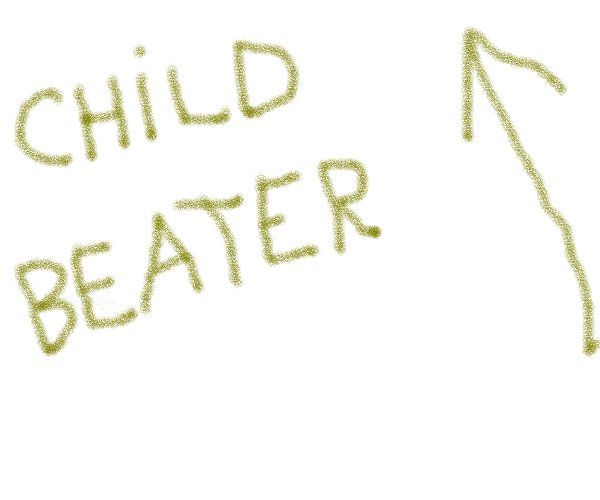
I, being the little terrorist that I could be then, opined how funny it would be to spray paint, “Child Kicker!” on face of his garage door, which shown down the entire street and anyone approaching from the south end would have a bird's eye view of it the whole way up.


My brother, stops talking and slowly turns his head and stares at me. It was that look people have when the proverbial light bulb goes off in their head.


“That's an excellent idea! You can sneak down there and do it! I'll take a picture of it!”


After hearing myself being volunteered for this operation, I start backing out right away. Getting caught vandalizing the hell out of someone's property was beyond even my idea of retribution.


I then throw the idea back into his lap. Instead of painting his garage, he should spray paint the street right in front of his house. I leave the room, go into the cellar and find a half pint can of gold spray paint. I bring it up to my brother, shaking it hard, clacking that little mixing ball inside of it.


“C'mon...I know you want to do it!” as I shake the can in front of his face.


It took a few minutes of convincing him. I kept dredging up the scene he saw when he was driving home that day. I then sealed the deal by acting as lookout if anyone should notice him doing this.


By this time it was around 2 AM and we shut the lights, TV and everything else off in our house. We looked like another home that was fast asleep and we tried to stifle our giggles should we wake our Mom. We got into our dark Wrangler jeans, which were so deeply dyed indigo that they might have passed for black. For shirts, we found some of our darkest ones. Ken then tells me that if we should be discovered, don't be stupid and run home. Run in the opposite direction like a jack rabbit and make my way home via the back fence


We quietly snuck out the kitchen door and walked down the street on it's darkside away from the street lights. I then started over by Mr. Ward's high bushes to hide myself and keep an eye and ear out for any late night cars or prying eyes.


My brother, then, runs to the cross of the T where our street and another met and got on his hands and knees and started to spray. What was funny was that he wasn't spraying a small sign, the message was about seven feet by three feet in size. He had to keep repositioning himself to get the whole thing done.


Here's what was spray painted on the street with a HUGE arrow pointing directly at the Carlson house. Don't forget, it's 7 feet long by 3 feet wide. You can't miss it!


We scrambled back, barely hiding our guffawing and back into our bedroom. We were successful, no one saw us.


The next morning, my brother had awoke much earlier than I did. He came upstairs as I was finally getting up and he tells me;


“I sort of took a walk to CVS, ya know, get a copy of Time magazine (which he had in his hands) and I saw every Carlson kid out there with paint rollers and a tray of gray paint.” He then bust out laughing.


“The bastard SENT his kids out there to paint it over!”


My brother left my room giggling to himself.


After getting ready, I rode my bike down the street to see the Carlson kids finishing up, and filling up, this huge gray square of gray paint on the street. Acting surprised and all innocent, I ask what they're doing.


The eldest boy Steve rushes up to me to inspect my hands.


“What are you doing? I ask.


“Do you have any gold spray paint! HUH?” Steven was a bit angry and paranoid at the same time.


I shoot back, “What the hell are you talking about? Why? You want spray paint for the thing your painting on the street? Why are you painting the street anyway?


Steve, once asked what he was doing, backed away and brushed me off with the wave of his arm. I did very well at not giving myself away.


Ken and I never told a soul about what we did. We'd bring the story up to ourselves during the week, with my brother goofing...”Ah Ha Ha! I love social condemnation!” Since we did such a great job at never being caught, the entire neighborhood started talking to one another about who did it. None of the adults suspected kids of pulling this off. For a good month, till the stories died away, the neighbor's came up with this scenario and that one, occasionally placing blame on this one or that. They only ones who would suspect us were the other kids. They knew my brother and I were good for fucking with people's heads if we were so in the mood. But none had any evidence to hang this one on us.


But here's what happened that we didn't predict or tried to accomplish. Mr Carlson didn't touch his kids for another year, as best as we could tell. All three got a reprieve. My brother and I didn't set out to have this occur. Hell, it never came up. What we wanted to do was bust this guys balls in the most public of all ways. That was the goof of it. However, things turned out a bit differently.


Now imagine, you wake up one day, and you find a billboard in front of your house, easily read by all the neighbors, of some very true fault you have. A fault that borders on evilness. I suppose you to would change your ways. If not, you'd slink around, avoiding any eye contact with people as you quickly hop into your car each morning to go to work. Mr Carlson sure did. He had a brilliant Scarlet Letter on his forehead for a good while. I think he got a message my brother and I never sent.


Tuesday, January 8, 2013


This is a good article on the middle class, how it came about and why it's getting it's head handed to them.


The Crisis of the Middle Class and American Power


By George Friedman

Founder and Chief Executive Officer/StratFor

Last week I wrote about the crisis of unemployment in Europe. I received a great deal of feedback, with Europeans agreeing that this is the core problem and Americans arguing that the United States has the same problem, asserting that U.S. unemployment is twice as high as the government's official unemployment rate. My counterargument is that unemployment in the United States is not a problem in the same sense that it is in Europe because it does not pose a geopolitical threat. The United States does not face political disintegration from unemployment, whatever the number is. Europe might.

 
At the same time, I would agree that the United States faces a potentially significant but longer-term geopolitical problem deriving from economic trends. The threat to the United States is the persistent decline in the middle class' standard of living, a problem that is reshaping the social order that has been in place since World War II and that, if it continues, poses a threat to American power.

 
The Crisis of the American Middle Class

 
The median household income of Americans in 2011 was $49,103. Adjusted for inflation, the median income is just below what it was in 1989 and is $4,000 less than it was in 2000. Take-home income is a bit less than $40,000 when Social Security and state and federal taxes are included. That means a monthly income, per household, of about $3,300. It is urgent to bear in mind that half of all American households earn less than this. It is also vital to consider not the difference between 1990 and 2011, but the difference between the 1950s and 1960s and the 21st century. This is where the difference in the meaning of middle class becomes most apparent.

 
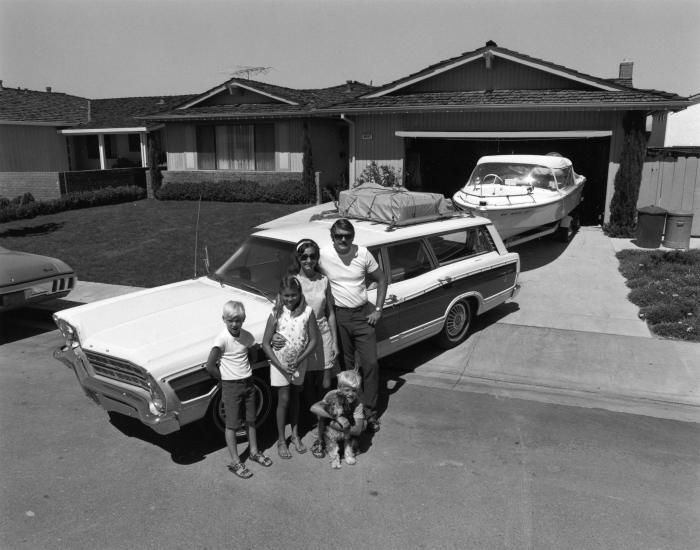
In the 1950s and 1960s, the median income allowed you to live with a single earner -- normally the husband, with the wife typically working as homemaker -- and roughly three children. It permitted the purchase of modest tract housing, one late model car and an older one. It allowed a driving vacation somewhere and, with care, some savings as well. I know this because my family was lower-middle class, and this is how we lived, and I know many others in my generation who had the same background. It was not an easy life and many luxuries were denied us, but it wasn't a bad life at all.

 
Someone earning the median income today might just pull this off, but it wouldn't be easy. Assuming that he did not have college loans to pay off but did have two car loans to pay totaling $700 a month, and that he could buy food, clothing and cover his utilities for $1,200 a month, he would have $1,400 a month for mortgage, real estate taxes and insurance, plus some funds for fixing the air conditioner and dishwasher. At a 5 percent mortgage rate, that would allow him to buy a house in the $200,000 range. He would get a refund back on his taxes from deductions but that would go to pay credit card bills he had from Christmas presents and emergencies. It could be done, but not easily and with great difficulty in major metropolitan areas. And if his employer didn't cover health insurance, that $4,000-5,000 for three or four people would severely limit his expenses. And of course, he would have to have $20,000-40,000 for a down payment and closing costs on his home. There would be little else left over for a week at the seashore with the kids.

 
And this is for the median. Those below him -- half of all households -- would be shut out of what is considered middle-class life, with the house, the car and the other associated amenities. Those amenities shift upward on the scale for people with at least $70,000 in income. The basics might be available at the median level, given favorable individual circumstance, but below that life becomes surprisingly meager, even in the range of the middle class and certainly what used to be called the lower-middle class.

 
The Expectation of Upward Mobility

 
I should pause and mention that this was one of the fundamental causes of the 2007-2008 subprime lending crisis. People below the median took out loans with deferred interest with the expectation that their incomes would continue the rise that was traditional since World War II. The caricature of the borrower as irresponsible misses the point. The expectation of rising real incomes was built into the American culture, and many assumed based on that that the rise would resume in five years. When it didn't they were trapped, but given history, they were not making an irresponsible assumption.

 
American history was always filled with the assumption that upward mobility was possible. The Midwest and West opened land that could be exploited, and the massive industrialization in the late 19th and early 20th centuries opened opportunities. There was a systemic expectation of upward mobility built into American culture and reality.

 
The Great Depression was a shock to the system, and it wasn't solved by the New Deal, nor even by World War II alone. The next drive for upward mobility came from post-war programs for veterans, of whom there were more than 10 million. These programs were instrumental in creating post-industrial America, by creating a class of suburban professionals. There were three programs that were critical:


1.The GI Bill, which allowed veterans to go to college after the war, becoming professionals frequently several notches above their parents.


2.The part of the GI Bill that provided federally guaranteed mortgages to veterans, allowing low and no down payment mortgages and low interest rates to graduates of publicly funded universities.


3.The federally funded Interstate Highway System, which made access to land close to but outside of cities easier, enabling both the dispersal of populations on inexpensive land (which made single-family houses possible) and, later, the dispersal of business to the suburbs.

 
There were undoubtedly many other things that contributed to this, but these three not only reshaped America but also created a new dimension to the upward mobility that was built into American life from the beginning. Moreover, these programs were all directed toward veterans, to whom it was acknowledged a debt was due, or were created for military reasons (the Interstate Highway System was funded to enable the rapid movement of troops from coast to coast, which during World War II was found to be impossible). As a result, there was consensus around the moral propriety of the programs.

 
The subprime fiasco was rooted in the failure to understand that the foundations of middle class life were not under temporary pressure but something more fundamental. Where a single earner could support a middle class family in the generation after World War II, it now took at least two earners. That meant that the rise of the double-income family corresponded with the decline of the middle class. The lower you go on the income scale, the more likely you are to be a single mother. That shift away from social pressure for two parent homes was certainly part of the problem.

 
Re-engineering the Corporation

 
But there was, I think, the crisis of the modern corporation. Corporations provided long-term employment to the middle class. It was not unusual to spend your entire life working for one. Working for a corporation, you received yearly pay increases, either as a union or non-union worker. The middle class had both job security and rising income, along with retirement and other benefits. Over the course of time, the culture of the corporation diverged from the realities, as corporate productivity lagged behind costs and the corporations became more and more dysfunctional and ultimately unsupportable. In addition, the corporations ceased focusing on doing one thing well and instead became conglomerates, with a management frequently unable to keep up with the complexity of multiple lines of business.

 
For these and many other reasons, the corporation became increasingly inefficient, and in the terms of the 1980s, they had to be re-engineered -- which meant taken apart, pared down, refined and refocused. And the re-engineering of the corporation, designed to make them agile, meant that there was a permanent revolution in business. Everything was being reinvented. Huge amounts of money, managed by people whose specialty was re-engineering companies, were deployed. The choice was between total failure and radical change. From the point of view of the individual worker, this frequently meant the same thing: unemployment. From the view of the economy, it meant the creation of value whether through breaking up companies, closing some of them or sending jobs overseas. It was designed to increase the total efficiency, and it worked for the most part.

 
This is where the disjuncture occurred. From the point of view of the investor, they had saved the corporation from total meltdown by redesigning it. From the point of view of the workers, some retained the jobs that they would have lost, while others lost the jobs they would have lost anyway. But the important thing is not the subjective bitterness of those who lost their jobs, but something more complex.

 
As the permanent corporate jobs declined, more people were starting over. Some of them were starting over every few years as the agile corporation grew more efficient and needed fewer employees. That meant that if they got new jobs it would not be at the munificent corporate pay rate but at near entry-level rates in the small companies that were now the growth engine. As these companies failed, were bought or shifted direction, they would lose their jobs and start over again. Wages didn't rise for them and for long periods they might be unemployed, never to get a job again in their now obsolete fields, and certainly not working at a company for the next 20 years.

 
The restructuring of inefficient companies did create substantial value, but that value did not flow to the now laid-off workers. Some might flow to the remaining workers, but much of it went to the engineers who restructured the companies and the investors they represented. Statistics reveal that, since 1947 (when the data was first compiled), corporate profits as a percentage of gross domestic product are now at their highest level, while wages as a percentage of GDP are now at their lowest level. It was not a question of making the economy more efficient -- it did do that -- it was a question of where the value accumulated. The upper segment of the wage curve and the investors continued to make money. The middle class divided into a segment that entered the upper-middle class, while another faction sank into the lower-middle class.

 
American society on the whole was never egalitarian. It always accepted that there would be substantial differences in wages and wealth. Indeed, progress was in some ways driven by a desire to emulate the wealthy. There was also the expectation that while others received far more, the entire wealth structure would rise in tandem. It was also understood that, because of skill or luck, others would lose.

 
What we are facing now is a structural shift, in which the middle class' center, not because of laziness or stupidity, is shifting downward in terms of standard of living. It is a structural shift that is rooted in social change (the breakdown of the conventional family) and economic change (the decline of traditional corporations and the creation of corporate agility that places individual workers at a massive disadvantage).

 
The inherent crisis rests in an increasingly efficient economy and a population that can't consume what is produced because it can't afford the products. This has happened numerous times in history, but the United States, excepting the Great Depression, was the counterexample.

 
Obviously, this is a massive political debate, save that political debates identify problems without clarifying them. In political debates, someone must be blamed. In reality, these processes are beyond even the government's ability to control. On one hand, the traditional corporation was beneficial to the workers until it collapsed under the burden of its costs. On the other hand, the efficiencies created threaten to undermine consumption by weakening the effective demand among half of society.

 
The Long-Term Threat

 
The greatest danger is one that will not be faced for decades but that is lurking out there. The United States was built on the assumption that a rising tide lifts all ships. That has not been the case for the past generation, and there is no indication that this socio-economic reality will change any time soon. That means that a core assumption is at risk. The problem is that social stability has been built around this assumption -- not on the assumption that everyone is owed a living, but the assumption that on the whole, all benefit from growing productivity and efficiency.

 
If we move to a system where half of the country is either stagnant or losing ground while the other half is surging, the social fabric of the United States is at risk, and with it the massive global power the United States has accumulated. Other superpowers such as Britain or Rome did not have the idea of a perpetually improving condition of the middle class as a core value. The United States does. If it loses that, it loses one of the pillars of its geopolitical power.

 
The left would argue that the solution is for laws to transfer wealth from the rich to the middle class. That would increase consumption but, depending on the scope, would threaten the amount of capital available to investment by the transfer itself and by eliminating incentives to invest. You can't invest what you don't have, and you won't accept the risk of investment if the payoff is transferred away from you.

 
The agility of the American corporation is critical. The right will argue that allowing the free market to function will fix the problem. The free market doesn't guarantee social outcomes, merely economic ones. In other words, it may give more efficiency on the whole and grow the economy as a whole, but by itself it doesn't guarantee how wealth is distributed. The left cannot be indifferent to the historical consequences of extreme redistribution of wealth. The right cannot be indifferent to the political consequences of a middle-class life undermined, nor can it be indifferent to half the population's inability to buy the products and services that businesses sell.

 
The most significant actions made by governments tend to be unintentional. The GI Bill was designed to limit unemployment among returning serviceman; it inadvertently created a professional class of college graduates. The VA loan was designed to stimulate the construction industry; it created the basis for suburban home ownership. The Interstate Highway System was meant to move troops rapidly in the event of war; it created a new pattern of land use that was suburbia.

 
It is unclear how the private sector can deal with the problem of pressure on the middle class. Government programs frequently fail to fulfill even minimal intentions while squandering scarce resources. The United States has been a fortunate country, with solutions frequently emerging in unexpected ways.

 
It would seem to me that unless the United States gets lucky again, its global dominance is in jeopardy. Considering its history, the United States can expect to get lucky again, but it usually gets lucky when it is frightened. And at this point it isn't frightened but angry, believing that if only its own solutions were employed, this problem and all others would go away. I am arguing that the conventional solutions offered by all sides do not yet grasp the magnitude of the problem -- that the foundation of American society is at risk -- and therefore all sides are content to repeat what has been said before.

 
People who are smarter and luckier than I am will have to craft the solution. I am simply pointing out the potential consequences of the problem and the inadequacy of all the ideas I have seen so far.